
What to film on a roofing job for social media: a shot list
A roofing shot list for social media: before and after, crew at work, ladder and drone shots, and the customer walk-around, with a short hook line for each.
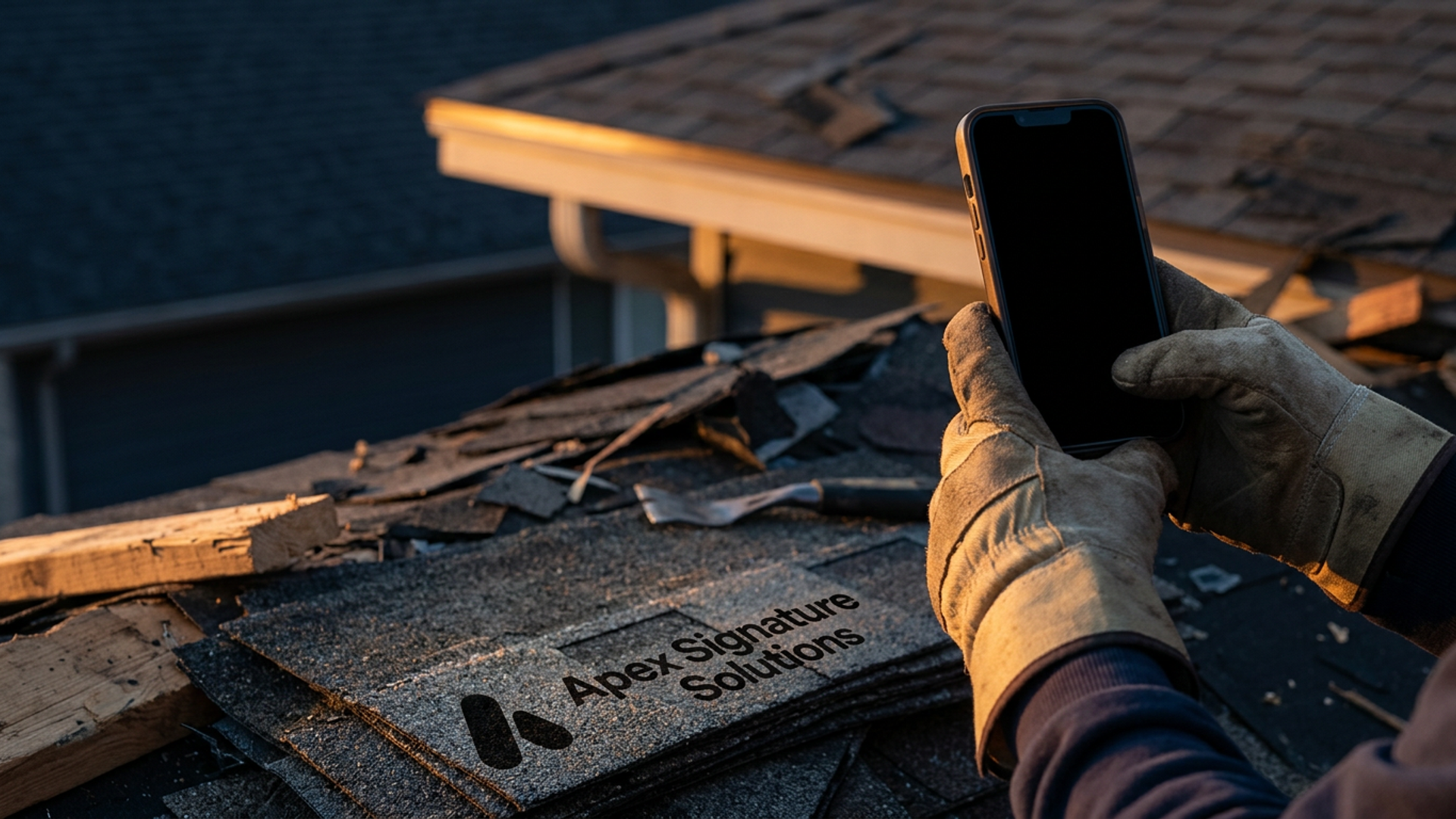
What to film on a roofing job for social media comes down to five shots: the roof before, the crew working, the view from the ladder or drone, the finished roof from the same spot, and the homeowner at the curb. Shoot each in under 20 seconds. Below is the shot list, with a hook line for each shot.
The roofing shot list at a glance
Roofing is the easiest trade to film because the work happens in plain sight and the homeowner rarely sees the top of their own roof. Your footage shows them something they cannot get any other way.
| Shot | Length | What the camera sees | Hook line |
|---|---|---|---|
| 1. Before | 10 to 15 sec | Damage from the ridge or ladder top | "This is what the homeowner could not see from the yard." |
| 2. Crew at work | 20 to 30 sec | Tear-off, underlayment, shingles going down | "Day one in [town]: old roof off before lunch." |
| 3. Ladder or drone | 10 to 15 sec | Slow pass over the whole roof | "Every slope of this roof, in 12 seconds." |
| 4. After | 10 to 15 sec | Same spot as shot 1, finished work | "Same spot. Same angle. Two days apart." |
| 5. Customer | 10 sec | Homeowner at the curb, face optional | "Ask the owner what he thinks of it." |
That adds up to about 90 seconds. It is the same length as the job clip our pipeline is built around. For the general five-shot method that works in every trade, see our job-site shot list by trade.
Before and after: film the same spot twice
Before-and-after is the strongest roofing clip, and it is the one most crews get wrong. They film the "before" from one place and the "after" from another, so nothing lines up.
Pick a marker on the first visit. A chimney, a vent stack, a valley, the corner of the garage. Stand in the same spot, hold the phone at the same height, and film for 10 seconds. On the last day, go back to that spot and repeat it.
Film the problem at close range too. Lifted flashing, cracked pipe boots, missing granules in the gutter, a soft patch of decking. A homeowner stops scrolling for a specific defect, not for a general shot of a roof.
Film the "before" first. Once the tear-off starts, it is gone.
Crew at work: show the process, not the mess
Prospects want to know who is going to be on their roof. A crew clip answers that without a word of sales talk.
Film three things, one angle each:
- Tear-off. Shingles sliding into the dump trailer. Loud, fast, easy to watch.
- Underlayment and flashing. Hands working the detail that homeowners assume you skip.
- Shingles going down. A row built across the slope, filmed from one fixed point.
Hold the phone still. Plant your feet. Do not film while moving across the pitch. Ask one crew member to be the camera person for the day, ideally the one on the ground or on the ladder, not the one carrying a bundle.
Add a voice note at the end. "Full replacement in [town], two-day job." Plain, no script.
Ladder and drone shots: the view the homeowner never gets
A ladder shot is free. Climb to the top rung, rotate the phone vertical, and pan once across the roof. Ten seconds is enough. Follow your own fall-protection rules and never film from a position you would not work from.
A drone adds the whole-roof view and the neighborhood. Fly a slow, straight pass at a steady height, then a wide shot that shows the street. That wide shot tells nearby homeowners the job happened close to them. Keep house numbers and license plates out of frame. If you fly a drone for business, check the current FAA requirements for your pilot certification before you post anything.
No drone? Skip it. A clean ladder pan does the same job on most single-story roofs.
Customer reaction: the clip that closes
The shot that moves a viewer from "nice work" to "I'll call them" is a real homeowner saying something real.
Ask for permission first. Then ask one question while they look at the finished roof: "What do you think?" or "What was the biggest worry before we started?" Let them answer in their own words. Do not script it, and do not post anything they have not agreed to.
If they decline to be on camera, film their reaction from behind, or film the walk-around with your voice only. A short quote on screen as text works too, with their written OK.
Never claim a reaction you did not capture, and never post a review that is not real.
How to turn each shot into a post
You do not need a new idea each week. Use the shot you already filmed as the hook.
- Pick one shot from the table above as the opening five seconds.
- Say the matching hook line out loud, with your town in it.
- Add a caption with the job, the town and a way to reach you.
- Upload the raw footage once a week to one folder.
More roofing hook lines and a caption example are in our post on video hook ideas for plumbers, HVAC and roofing. This post covers what to point the camera at. That one covers what to say over it.
Your next step
Download the free script pack. Pick roofer and you get ten hook lines, three caption templates and an end-card script written for your trade. Then film one job this week with the five shots above.
If you would rather not edit, send us 1 to 3 raw clips through the free pilot. We return a trimmed vertical clip, an ad variant for Facebook and Instagram, and a caption set. No charge, no commitment. You can see what a roofing sample looks like on the roofer pilot page first.